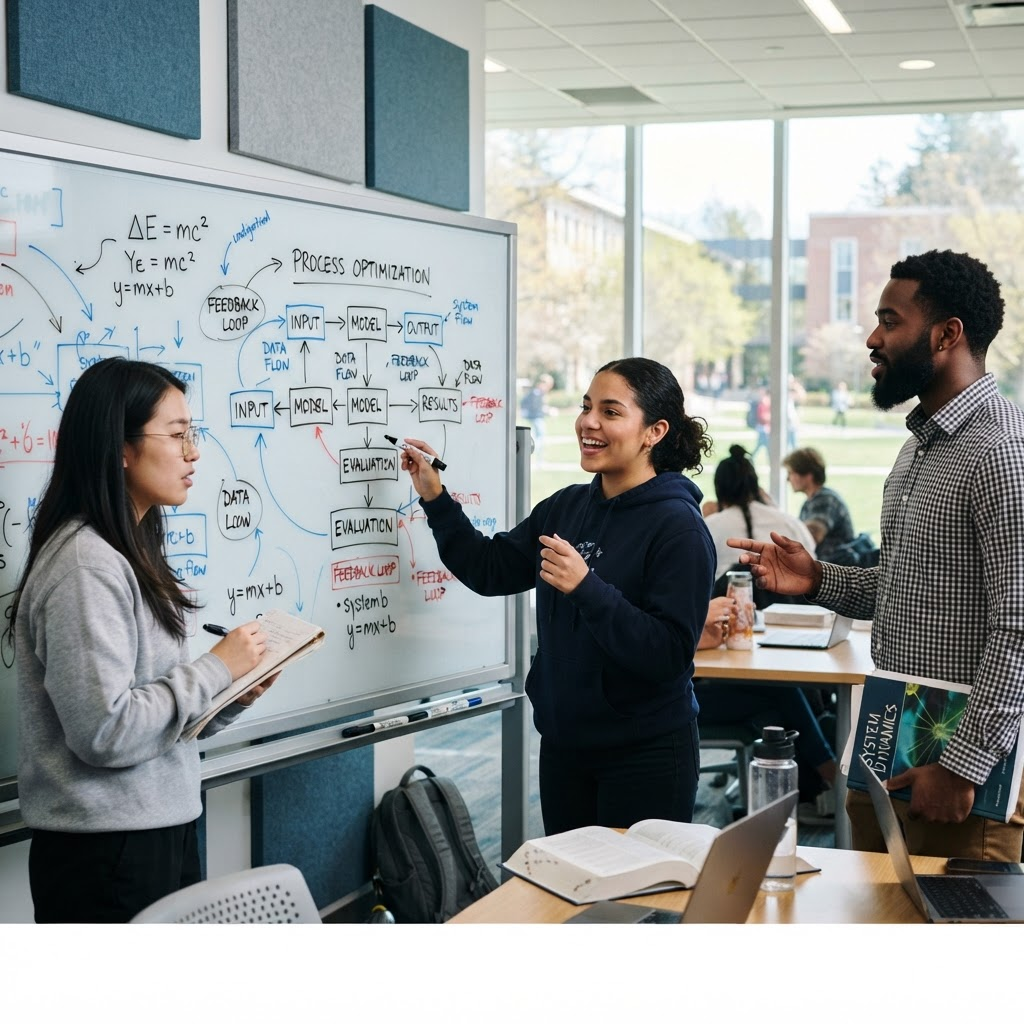
Active Learning Techniques for Students: What They Are and Why They Work
Active learning is commonly used to outperform passive studying — active learning students score half a standard deviation higher on exams. This guide covers 10 active learning techniques, the science behind them, and how to apply each in real study sessions.
Edumika Editorial Team
Editorial Team
What Makes Learning "Active"
The term "active learning" is often misused to mean any physically engaged classroom activity — group work, discussions, lab sessions. But the research definition is more specific and more powerful: active learning is any process that requires the learner to mentally generate output rather than passively receive input.
The critical variable is generation. When you read a definition, your brain recognizes it. When you close your notes and try to recall and write that definition, your brain must retrieve and reconstruct it. The retrieval attempt — successful or not — produces a fundamentally different kind of memory encoding than passive recognition does. This is the core mechanism behind why active learning outperforms passive learning so consistently.
For students studying independently, this means the most important shift is not what you study but what you do with what you study. The 10 techniques below range from immediately applicable (you can use them in your next study session) to more involved approaches that transform how you engage with entire subjects.
Technique 1: Retrieval Practice (The Testing Effect)
Retrieval practice is the most extensively researched and consistently effective active learning technique. The principle: instead of reviewing material by re-reading, you test yourself on it — forcing your brain to retrieve information from memory rather than recognize it from a page.
The science: a landmark 2008 study by Roediger and Karpicke at Washington University showed that students who studied material once and then practiced retrieving it (via three tests) retained 80% of the material after one week. Students who studied the same material four times with no retrieval practice retained only 36%. Re-reading creates an illusion of mastery — material feels familiar, which the brain misinterprets as known. Retrieval practice exposes what you actually know versus what you merely recognize.
How to apply it: after reading a section, close your notes and write down everything you can remember. Use flashcard apps like Anki with spaced repetition. Work through past exam papers without looking at your notes first. Generate your own quiz questions as you study. The retrieval attempt itself — even an unsuccessful one — strengthens memory far more than passive review.
Technique 2: The Feynman Technique
Named after physicist Richard Feynman, this technique uses attempted explanation as a diagnostic tool. The process: take a blank sheet of paper, write a concept at the top, and explain it from scratch in plain language — no jargon, no technical shorthand — as if teaching it to a curious 12-year-old.
The power of this technique is what it reveals. Most students, when they try this for the first time, discover that their understanding of familiar concepts is far shallower than they realized. They can recognize terms and recall definitions, but cannot explain why something works or how the pieces fit together. The point in the explanation where you get stuck or have to resort to unexplained jargon is exactly where your understanding has a gap.
After identifying gaps, return to the source material, address those specific points, and try the explanation again. Repeat until you can explain the concept completely, simply, and from first principles. This technique is particularly valuable for abstract or complex subjects — theoretical concepts in physics, economics, philosophy, or programming — where surface familiarity can mask poor understanding for a long time.
Technique 3: Spaced Practice
Spaced practice (also called distributed practice) means spreading study sessions over time rather than massing them into a single long session. Studying chemistry for one hour on Monday, Wednesday, and Friday produces significantly better retention than studying chemistry for three hours on a single Saturday — even though the total time is identical.
The mechanism is the spacing effect: information reviewed at increasing intervals requires greater retrieval effort each time, which strengthens the memory trace. The forgetting curve (documented by Hermann Ebbinghaus in 1885 and extensively replicated since) shows that memory declines rapidly after first learning and then plateaus — revisiting material just before it would be forgotten re-consolidates the memory at a higher retention level.
In practice: review lecture material the same day it is covered, again after two to three days, again after a week, and again two weeks later. Spaced repetition flashcard apps like Anki automate this scheduling precisely. For a comprehensive overview of Anki and similar tools, see our guide to spaced review and flashcards.
Technique 4: Interleaving
Interleaving means mixing different types of problems or different subjects within a single study session, rather than studying one topic in a block until you feel competent and then moving to the next (called "blocking").
Counterintuitively, interleaved practice feels harder and produces worse immediate performance than blocked practice — but produces significantly better long-term retention and transfer (the ability to apply knowledge to new problem types). A 2015 study by Kornell and Bjork found that interleaved study produced 43% better performance on a final test compared to blocked study, despite students rating interleaving as less effective during the study session.
For mathematics and problem-solving subjects, this means mixing problem types rather than drilling one type to mastery before moving to the next. For language learning, it means mixing vocabulary, grammar, and reading rather than studying each in isolation. The difficulty of interleaving is the point — it forces your brain to identify which approach applies to each situation, which is exactly what an exam requires.
Technique 5: Elaborative Interrogation
Elaborative interrogation involves asking "Why does this make sense?" and "How does this connect to what I already know?" after encountering each fact or concept. Instead of accepting a fact at face value ("Mitochondria produce ATP"), you generate a causal explanation ("Mitochondria produce ATP because they have the membrane structure and enzyme machinery needed for oxidative phosphorylation — a process that converts the energy in glucose into a form cells can use directly").
Research shows that generating explanations — even incorrect ones that you then refine — produces significantly better retention than passive reading or rote repetition. The act of constructing a "why" creates a richer, more integrated memory representation that is more resistant to forgetting and more flexible in application.
Technique 6: Practice Testing Under Exam Conditions
Working through past exam papers and practice tests is one of the highest-value study activities available to students preparing for exams. It works as active learning for two reasons: it forces retrieval of knowledge under time pressure (strengthening memory), and it builds familiarity with the specific format, question types, and cognitive demands of the actual exam.
The critical implementation detail: do practice exams under realistic conditions — timed, no notes, quiet environment. Students who do timed practice exams consistently outperform those who work through the same questions in a relaxed, open-note format. See our guide on how to study effectively for exams for a complete exam preparation framework.
Technique 7: Teaching Others (Protégé Effect)
The act of explaining or teaching a concept to another person is one of the most powerful active learning experiences available. Research by John Nestojko at Washington University found that students who were told they would later teach material to others learned it more thoroughly — with better organization and deeper understanding — than students who expected only to take a test on it.
The mechanism is called the protégé effect: when you expect to teach, you study with a focus on understanding and organizing the material for explanation, not just for recognition. You anticipate questions. You look for analogies. You trace causal chains. All of these produce deeper processing and more durable memory.
Practical applications: join or form a study group where members take turns explaining topics to each other. Use the Feynman Technique (explain to yourself). Record short voice memos explaining a concept after studying it. See our guide to effective study groups for how to structure peer teaching sessions.
Technique 8: Mind Mapping and Concept Mapping
Mind mapping and concept mapping are visual active learning tools that require you to identify relationships between ideas — not just list them. Creating a concept map forces you to determine how concepts connect to each other, which concepts are superordinate (broader) versus subordinate (more specific), and what the causal or logical relationships between them are.
The active learning value comes from the construction process, not the map itself. Building a concept map from memory after studying (rather than while looking at notes) combines retrieval practice with relationship building — two high-value cognitive activities. Research by Ausubel and Novak consistently shows that concept mapping improves both understanding and retention compared to passive note-taking.
Technique 9: Problem-Based Learning
Problem-based learning (PBL) centers study sessions on attempting to solve a real or realistic problem before receiving instruction — the struggle activates prior knowledge, makes you aware of gaps, and primes you to learn more effectively when the instruction or explanation follows.
For students, this means: before reading a chapter, attempt to solve a representative problem using only what you already know. You will almost certainly be unable to solve it fully. But the attempt activates relevant knowledge, creates specific questions ("I got stuck on X — how does that work?"), and makes the subsequent reading far more purposeful and comprehensible. Research by Kapur on "productive failure" demonstrates that students who struggle with problems before instruction consistently outperform those who receive instruction first.
Technique 10: Dual Coding
Dual coding involves combining verbal and visual representations of the same information — for example, creating a diagram to accompany a written explanation, or drawing a flowchart after reading a process description. Research by Allan Paivio on dual coding theory shows that information encoded in two modalities (verbal and visual) is more deeply processed and more reliably retrieved than information encoded in one modality alone.
For students: whenever you study a process, timeline, or set of relationships, draw it as a diagram. When you study a concept, also write it out. The translation between modalities — converting words into a diagram, or a diagram into an explanation — is itself an active learning act that deepens encoding. This pairs naturally with effective note-taking methods that combine diagrams and written explanations.
Frequently Asked Questions
What is active learning and how is it different from passive learning?
Active learning is any study approach that requires the learner to mentally process, manipulate, or apply information rather than simply receive it. Passive learning involves one-way information transfer — the student listens to a lecture, watches a video, or reads text without generating any output. The distinction is not about physical activity (you can be sitting still and learning actively) but about cognitive engagement. In passive learning, the brain receives input. In active learning, the brain must do something with that input: answer a question, solve a problem, explain an idea, generate an example, or make a prediction. A 2014 meta-analysis by Freeman et al. published in PNAS analyzed 225 studies and found that active learning produced exam scores half a standard deviation higher on average than traditional lecturing — the equivalent of roughly a full letter grade. The effect was consistent across class sizes, disciplines, and institution types.
What are the most effective active learning techniques for students?
The most evidence-backed active learning techniques for independent study are: (1) Retrieval practice — testing yourself on material rather than re-reading it. This is the single highest-impact study technique documented in cognitive science research. (2) The Feynman Technique — attempting to explain a concept from scratch in simple language, identifying where you get stuck, and returning to the material to fill those gaps. (3) Spaced practice — distributing study sessions over time rather than massing them into single long sessions. (4) Interleaving — mixing different problem types or subjects within a single study session rather than blocking by topic. (5) Elaborative interrogation — asking "why does this make sense?" and generating explanations for facts. (6) Practice testing — working through past exam papers, problem sets, or self-generated quizzes under realistic conditions. Each of these has a strong evidence base, and they can be combined for greater effect.
Is active learning better than reading and note-taking?
Active learning consistently outperforms passive reading and note-taking for long-term retention and deep understanding — but reading and note-taking are still necessary as a first step. The limitation of passive reading and note-taking is not that they are useless but that students often stop there, treating the first pass through material as sufficient. Active learning works best as a follow-up to reading: after reading a section, close your notes and test your recall (retrieval practice), explain the concept out loud (Feynman Technique), or work a practice problem (application). This combination — passive initial acquisition followed by active processing — consistently outperforms either approach alone.
How do I use the Feynman Technique step by step?
The Feynman Technique involves four steps: (1) Choose a concept you want to learn and write its name at the top of a blank page. (2) Explain the concept in plain language as if teaching it to someone with no background in the subject — use simple words, no jargon, and build from first principles. Write this explanation out. (3) Review your explanation and identify the gaps — every point where you could not explain clearly or had to use jargon you could not define is a comprehension gap. (4) Return to your source material, fill the gaps, and re-explain. Repeat until you can explain the concept from beginning to end in plain language without gaps. Named after physicist Richard Feynman, the technique works because the attempt to explain exposes what you actually understand versus what you merely recognize when you see it. Most students discover far more gaps than they expected on step 3.
What is retrieval practice and why is it so effective?
Retrieval practice means recalling information from memory instead of only reviewing a source. It gives you feedback about what you can produce without looking and shows which ideas need another explanation. Try it with flashcards, past exam questions, self-generated quizzes, or the Recite step of SQ3R. Keep the constraint clear: answer from memory first, then check the source and correct gaps.
Can active learning techniques help with difficult or abstract subjects?
Active learning can be adapted to difficult and abstract subjects, but the activity should match the material. In mathematics, try solving a problem before checking a worked example. In conceptual subjects, explain an idea in plain language and mark the parts you cannot support. For memorization-heavy subjects, use retrieval questions or spaced review. The common thread is checking what you can produce, not only what looks familiar on the page.
Sources and further reading
These links support the research or guidance discussed in this article. They are provided for readers who want to check the original material.