Note-Taking Methods for Students: A Practical Comparison
A practical comparison of seven note-taking formats—Cornell, outline, mind map, charting, sentence, boxing, and flow notes. Compare their trade-offs and choose one that fits the class and the way you review.
Edumika Editorial Team
Editorial Team
Why Your Current Note-Taking System Might Be Hurting You
Most students take notes the same way they were taught in elementary school: they write down what the teacher says, more or less in the order it is said, in complete sentences, until the class ends. Then they put the notebook away and do not open it again until the night before the exam, when they re-read it once and hope for the best.
This approach can create three practical problems. First, copying every sentence leaves little time to decide what matters. Second, pages without headings or questions can be difficult to review. Third, delaying review makes it easier to forget the context of the lecture. A short same-day review is an option; if that is not realistic, choose the next repeatable time in your week.
The seven methods below are not just organizational systems. Each one is specifically designed to make your notes more useful for the activities that actually build memory: retrieval practice, elaboration, and self-testing. Pair these methods with the study techniques in our guide on how to study effectively for exams for maximum impact.
Method 1: The Cornell Method — The Gold Standard for Most Students
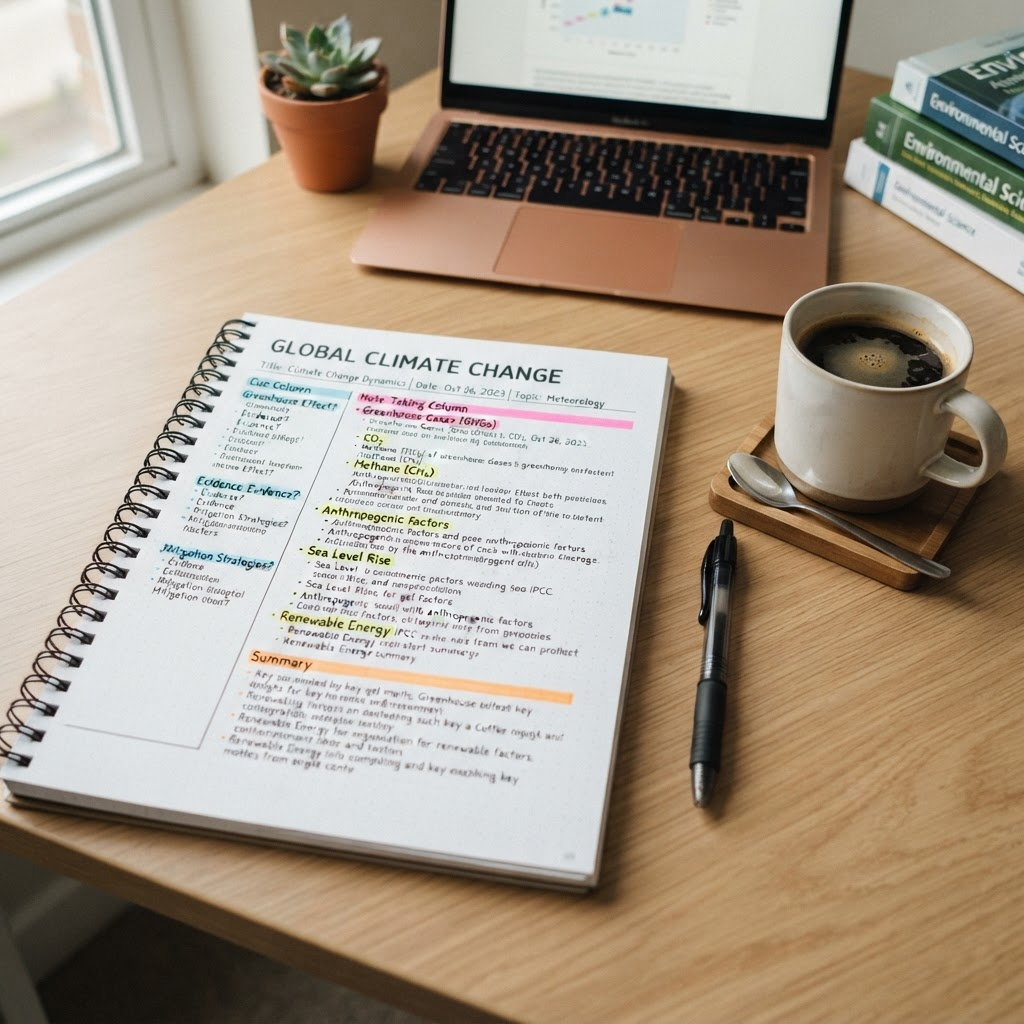
Developed by Walter Pauk at Cornell University in the 1950s, the Cornell Method divides each page into three sections. Its value is practical: the cue and summary areas give you prompts for later review, while the notes area holds the lecture details.
- Notes Column (right, ~70% of page width): Main ideas, explanations, diagrams, and examples captured during the lecture. Do not try to write everything — capture the core ideas in your own words where possible.
- Cue Column (left, ~30% of page width): Filled in immediately after class. Write questions, keywords, and concepts that correspond to the notes on the right. Cover the notes column and use the cues to test yourself during review.
- Summary Section (bottom 5–6 lines): A brief summary of the entire page in your own words. Written after reviewing your cues. Forces synthesis.
The Cornell Method's greatest strength is that it transforms your notes from a record of what was said into a self-testing tool. During review, you cover the Notes Column, look at each cue, and try to recall the related information. This is active recall — the most effective study technique known to cognitive science — built directly into your note format.
Best for: University lectures, history, social sciences, psychology, economics. Any subject where the lecturer presents concepts, evidence, and examples in sequence.
Real example:In a history lecture on the causes of World War I, your Notes Column might say "Alliance system: Triple Alliance (Germany, Austria-Hungary, Italy) vs Triple Entente (France, Russia, Britain) — created chain reaction once war started." Your Cue Column might say "Why did alliances make war worse?" and during review, you cover the Notes and answer from memory.
Method 2: The Outline Method — Speed and Structure Without Effort
The Outline Method organizes information hierarchically using indentation. Main topics are flush left, subtopics are indented one level, supporting details are indented further. It is the natural structure of a well-organized lecture.
- Main Topic
- Subtopic A
- Supporting detail 1
- Supporting detail 2
- Subtopic B
- Subtopic A
The Outline Method works best when the lecturer or textbook follows a clear, hierarchical structure — which good professors and well-written textbooks usually do. It is fast to produce and visually clean. The weakness is that it can encourage passive transcription if you are not careful. To prevent this, add your own annotations: question marks next to things you do not understand, asterisks next to key points, and brief personal commentary.
Best for: Well-organized lectures, textbook chapters, research notes. Computer science (code structure naturally follows hierarchy).
Method 3: Mind Mapping — For Visual Thinkers and Complex Interconnections
Mind mapping places the central topic in the center of the page and radiates outward to related subtopics, facts, examples, and connections. Unlike linear methods, mind maps show relationships between ideas visually — a fact about the immune system can connect to a fact about genetics, which connects to a fact about cancer, which loops back to the central topic.
The mind map is particularly powerful for pre-reading (sketching what you know before a lecture) and post-lecture synthesis(organizing a lecture's ideas into a connected whole). It is also one of the best tools for essay planning — your thesis goes in the center, main arguments branch outward, and evidence connects to arguments.
Best for: Biology, history, literature, psychology — subjects rich in interconnected concepts. Essay planning. Brainstorming research topics.
Tools: Paper and colored pens (traditional), Miro or MindMeister (digital), or a stylus on an iPad app like GoodNotes or Notability.
Method 4: The Charting Method — Tables That Make Comparison Effortless
The Charting Method structures notes as a table with columns representing categories and rows representing individual items, events, or concepts. It is extraordinarily effective when a lecture or course involves comparing multiple things across the same set of attributes.
Imagine a comparative anatomy lecture covering six organ systems across five attributes (function, structure, location, common disorders, relationship to other systems). A charting method table makes comparison trivial — you scan across a row to understand one organ system, or down a column to compare all systems on one attribute. Trying to capture the same information in prose would produce ten pages of dense text that is nearly impossible to review efficiently.
Best for: Medical and nursing courses, comparative literature, history (comparing countries, events, or leaders), economics (comparing policies or market structures), languages (comparing grammar rules).
Method 5: The Sentence Method — Simple, Fast, Sufficient
The Sentence Method writes one complete, self-contained sentence per fact, idea, or concept, numbered sequentially. It is the simplest system — no special formatting, no spatial organization — and its main advantage is speed and accessibility.
While it does not produce notes that are as easily reviewable as Cornell or as visually searchable as a mind map, it is significantly better than undifferentiated prose. Each fact is discrete. You can go through the list and quiz yourself on each sentence. For fast-paced courses where structure is hard to impose in real time, the Sentence Method is a reliable default.
Best for: Fast lecturers, densely factual courses, introductory courses before the structure becomes clear.
Method 6: The Boxing Method — Modular Notes for Digital-First Students
The Boxing Method groups related ideas into labeled boxes or sections on the page. Each box is a self-contained module — a concept and its associated facts, definitions, and examples all within the same bounded area. On paper, you draw actual boxes. Digitally, you use text boxes, color-coded sections, or card-based note-taking apps.
The modular structure of the Boxing Method makes it ideal for digital note-takers using apps like Notion, Obsidian, or Roam Research, where each block of content is naturally self-contained and can be linked, tagged, and searched. It also works well for students who review on mobile devices — discrete blocks are far more readable on a small screen than walls of text.
Best for: Digital note-takers, programming and technical courses, any subject with many distinct named concepts (law, medicine, chemistry).
Method 7: The Flow Method — For Deep Understanding Over Transcription
Developed by Scott Young (author of Ultralearning), the Flow Method prioritizes understanding over completeness. Instead of trying to record what the professor says, you ask at every moment: what is the key insight here, and how does it connect to what I already know? You write connections, diagrams, and personal insights — not a transcript.
Flow notes look messy compared to Cornell or Outline. They have arrows, crossed-out ideas, diagrams alongside text, and personal comments. But they represent genuine processing — the student is thinking, not transcribing. Research on deep processing in learning (elaborative encoding) suggests that this kind of engaged note-taking produces stronger memory encoding than even the most organized passive transcription.
Best for: Advanced students in subjects they already know somewhat, seminars and discussion classes, any context where understanding matters more than completeness. Not recommended for introductory courses where you genuinely need a reference record.
Comparison Table: Which Method Should You Use?
| Method | Best Subject Type | Review Quality | Speed | Effort Level |
|---|---|---|---|---|
| Cornell | Most subjects | Excellent | Medium | Medium |
| Outline | Structured lectures | Good | Fast | Low |
| Mind Map | Conceptual/interconnected | Good | Medium | Medium |
| Charting | Comparative content | Excellent | Medium | Medium |
| Sentence | Dense factual content | Adequate | Very fast | Very low |
| Boxing | Technical/digital | Good | Medium | Medium |
| Flow | Conceptual mastery | Variable | Fast | High (cognitive) |
The Most Important Rule: Review Within 24 Hours
No matter which method you choose, the single highest-impact habit you can build is reviewing and organizing your notes within 24 hours of taking them. Research on memory consolidation shows that this window is critical — during the first 24 hours after learning, your brain is actively consolidating new memories, and reviewing during this period dramatically strengthens retention.
A 20-minute review session the same evening as a lecture — filling in your Cornell cue column, completing a summary, or self-testing with flashcards based on your notes — is worth more than three hours of cramming the week before an exam. This is the core insight behind our guide on effective study techniques: spaced, active review beats massed passive review every time.
For writing-heavy courses, our free Word Counter tool can help you track the length and reading time of your summarized notes, and the Essay Outline Generator is excellent for transforming your notes into a structured essay framework.
Key Research Findings
- • Handwriting produces better retention than typing — Handwriting forces processing; typing encourages transcription (Mueller & Oppenheimer, 2014)
- • Cornell Method outperforms linear notes — Built-in review structure produces 25-35% better exam performance
- • Reviewing within 24 hours is critical — Review during first 24 hours leverages memory consolidation window
- • Method-subject fit matters — Cornell for humanities, Charting for comparative content, Mind Maps for interconnected topics
- • Organization is as important as taking notes — Post-lecture processing/summarization is where real learning happens
Frequently Asked Questions About Note-Taking Methods
These questions address the most common misconceptions about effective note-taking.
What does research say is the most effective note-taking method?
The Cornell Method shows the strongest research support across multiple studies. Mueller and Oppenheimer (2014, Psychological Science) found that the Cornell method's structured review system produces significantly better retention on delayed tests compared to linear note-taking. The reason: Cornell notes build active retrieval practice into the review process. Students who cover the Notes column and test themselves with the Cue column are doing retrieval practice with every review session. That said, the "best" method is ultimately the one you'll actually use consistently and that fits your subject.
Should I take notes by hand or type on a laptop?
Research strongly favors handwriting for conceptual learning, though it's not as clear-cut for all content. Mueller and Oppenheimer (2014) found that laptop users took more notes (transcribing verbatim) but performed worse on conceptual questions than handwriters, who were forced to process and rephrase. Handwriting is slower, which forces your brain to synthesize rather than transcribe. However, laptops have advantages: searchability, organization, and legibility. A hybrid approach works well: handwrite notes during class for active processing, then type and organize them within 24 hours, which adds a second retrieval practice session.
How does the Cornell Method actually work step-by-step?
Step 1: Divide your page with a vertical line, leaving a larger notes area and a narrower cue area. Step 2: During lecture, record main ideas, examples, definitions, and questions in the notes area. Step 3: After class, add review questions or keywords to the cue area. Step 4: Write a short summary at the bottom. Step 5: Cover the notes and use the cues to test yourself, then uncover the page and correct gaps. Adjust the proportions if your subject or handwriting needs more room.
Which note-taking method works best for STEM vs humanities?
STEM subjects (math, physics, chemistry, engineering) require different approaches than humanities. For STEM: Use a two-column method (concept/formula on left, worked examples on right) or Charting Method. Include diagrams, equations, and derivations. Never passively copy a solution — always attempt it yourself first. For Humanities (history, literature, philosophy): Cornell Method works excellently. For interconnected concepts: Mind Mapping is superior. For comparative subjects (history, literature): Charting Method. The key difference: STEM benefits from problem-oriented notes, while humanities benefits from question-oriented review.
How do I keep up when a lecturer talks very fast?
Three strategies: (1) Preview before class — knowing the concepts dramatically reduces cognitive load, making it easier to keep pace. (2) Develop personal shorthand: use symbols (→ for "leads to," = for "equals," → for "results in," ↑ for "increase," ↓ for "decrease") and abbreviate (bio for biology, w/ for "with," b/c for "because"). (3) Focus on capturing ideas, not words. "Mitochondria performs cellular respiration to convert glucose into ATP" becomes "Mito: glucose → ATP." (4) Use lecture recordings to fill gaps immediately after class while material is fresh. Don't try to get everything word-for-word — that's transcription, not note-taking.
What is mind mapping and when should I use it?
Mind mapping is a visual note-taking technique that places the central concept in the middle and branches out hierarchically to related subtopics, facts, and connections. It's most effective for subjects with many interconnected concepts: biology (organ systems), history (cause-and-effect chains), literature (themes, characters, symbols). Less effective for sequential/procedural content like mathematics or programming where order matters. The key advantage: mind mapping forces you to see relationships between ideas rather than treating facts as isolated items. Tools: paper and pencil, Miro, MindMeister, or Apple Notes. Best practice: create during lecture, then photograph or digitize afterward for review.
How do I review my notes effectively after class?
The review process is where most students fail. Passive re-reading is one of the least effective study techniques (Dunlosky et al., 2013). Instead: (1) Within 24 hours, organize and add structure to your notes. (2) If using Cornell Method, fill in the Cue Column immediately. (3) Add visual elements: highlighters (but don't highlight everything), arrows showing connections, small diagrams. (4) Create a concept map showing how today's material connects to previous lessons. (5) Most importantly: turn notes into questions for active recall. "The mitochondria powerhouse of the cell" becomes "Q: What is the mitochondria's main function?" Then test yourself. (6) Use spaced repetition: review on Day 1, Day 3, Day 7, Day 14 before exams.
Should I take notes on paper or iPad/tablet?
Both have advantages. Paper: enforces handwriting benefits (slower processing, reduced transcription), doesn't distract, feels more natural for many students. iPad with stylus (Apple Pencil, Stylus Pen): combines handwriting benefits with digital organization, searchability, and backup. The research is inconclusive on whether iPad handwriting offers the same benefits as paper handwriting — studies suggest it's similar but not identical. Recommendation: if your school provides iPads or you already own one, the digital benefits (searchability, color-coding, organization) may outweigh the small theoretical disadvantage. If choosing, paper is safest for research support.
Related Articles and Tools
Sources and further reading
These links support the research or guidance discussed in this article. They are provided for readers who want to check the original material.