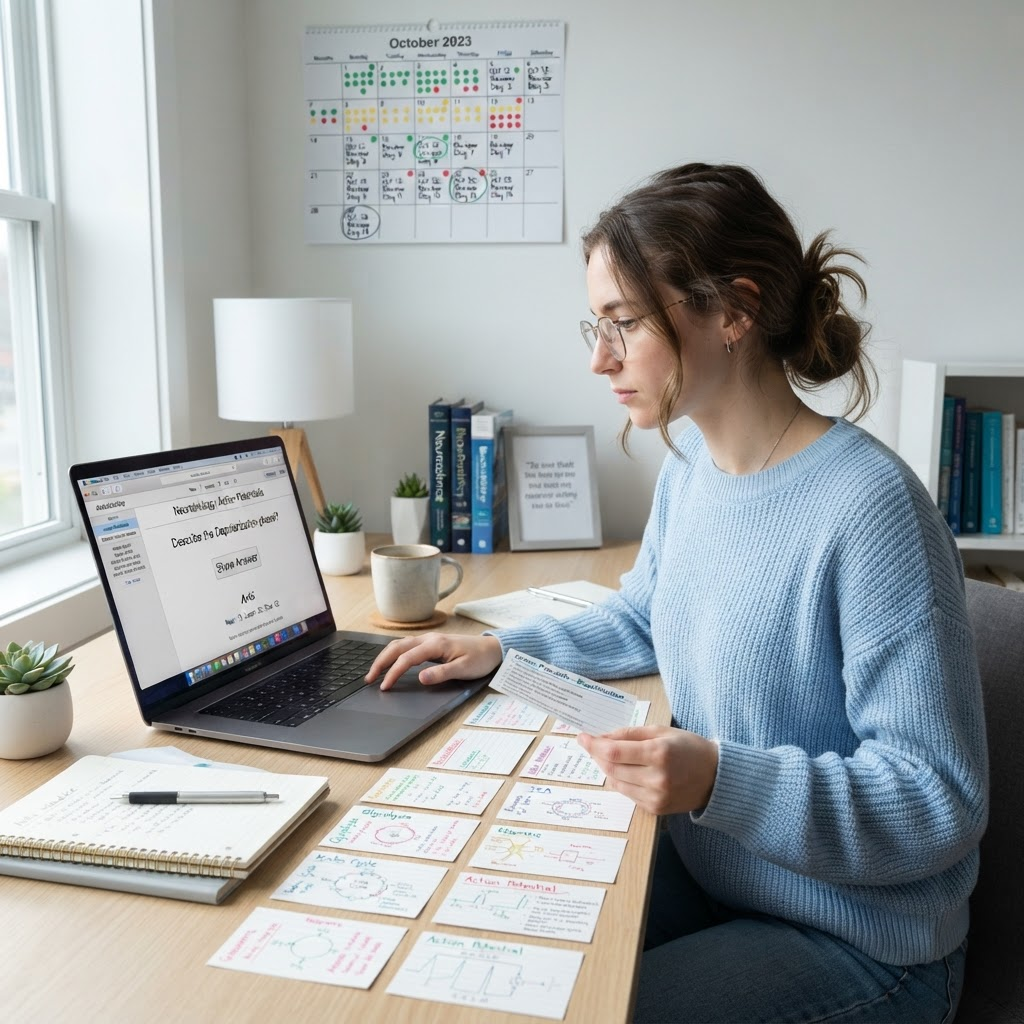
Spaced Repetition and Flashcards: A Practical Review Guide
Learn when flashcards help, how to write useful prompts, and how to schedule review without turning every subject into a card deck.
Spaced repetition is a useful review option when you need to remember facts, vocabulary, formulas, or definitions over time. It is not a complete study system for every subject, so combine it with practice problems, explanation, and feedback where appropriate.
Medical students use it to pass board exams. Language learners use it to become fluent. High school students use it to ace cumulative exams. The research backing spaced repetition is overwhelming — and yet most students have never heard of it.
Illustrative Flashcard Scenario
Example: A student preparing for a cumulative science exam could turn definitions and processes into short prompts, review the cards due that day, and pair them with practice questions. The cards would support recall, but they would not replace understanding, problem solving, or feedback.
Why it worked: Spaced repetition prevented the constant forgetting that derailed traditional cramming. Each card appeared at optimal difficulty intervals. Her brain had to struggle (which builds memory), but not so much that she quit in frustration.
What Is Spaced Repetition?
Spaced repetition is a study technique where you review material at increasing intervals. Instead of cramming, you see the same information multiple times over days or weeks, with gaps between reviews.
Example schedule for one flashcard:
- Day 1: Study the card
- Day 2: Review the card
- Day 5: Review again
- Day 12: Review again
- Day 30: Final review
The key insight: each time you struggle to recall something from memory, your brain strengthens that memory pathway. This is called the testing effect or retrieval practice, and it is far more powerful than passive re-reading.
Why Spaced Repetition Works (The Science)
Recall can weaken when new material is not revisited. The forgetting curve is a useful model for why short, spaced review sessions can help you notice and repair gaps.
But here is the remarkable part: each time you retrieve a memory before completely forgetting it, the forgetting curve flattens. Your next forgetting curve is slower. Review again before forgetting, and it flattens further. Eventually, the information lives in long-term memory.
The three pillars of effective memory:
- Encoding: Understanding the material when you first learn it
- Retrieval practice: Actively recalling (not just reading) the material
- Spacing: Spreading reviews over time, not cramming
Spaced repetition optimizes all three. You encode material into flashcards, practice retrieval each time you review, and space it perfectly using algorithms.
How to Use Anki (Step-by-Step)
Anki is the most popular spaced repetition app because it is free, open-source, and highly customizable. Here is how to get started:
Step 1: Download and Install
Download Anki from ankiweb.net (free). It works on Windows, Mac, Linux, and mobile (AnkiDroid on Android, AnkiWeb on iPhone).
Step 2: Create Your First Deck
A deck is a collection of flashcards. Create one for each subject or course. For example: "Biology 101" or "Spanish Vocab".
Step 3: Add Cards
Click "Add" to create flashcards. Write the question on the front, answer on the back. Be specific — one fact per card. Example: Front: "What is photosynthesis?" Back: "Process where plants convert light energy into chemical energy."
Step 4: Study Daily
Click "Study" to begin your daily session. Anki shows you cards due for review. Rate each answer (Again, Hard, Good, Easy) and Anki calculates when to show it next.
Step 5: Trust the Algorithm
Anki's algorithm (SM2) is optimized for long-term retention. Do not skip reviews or adjust settings obsessively — just study consistently.
Illustrative Examples: Before and After a Review Change
The scenarios below are illustrative, not reported case studies. Use them to think through what might change when you replace rereading with retrieval and spaced review.
Example: A history review plan
Before: A student rereads history notes but has trouble recalling dates and causes without seeing the page.
After: The student turns key relationships into prompts, attempts recall, and checks the answer. Practice questions are added so the student also works on explanation and transfer.
Example: Language vocabulary review
The Challenge: A language learner needs to remember vocabulary beyond the week it was introduced. A deck can pair short prompts with example sentences and schedule review across several days.
Check: Periodically remove or rewrite cards that test recognition but not recall, and use conversation or writing practice to see whether the vocabulary transfers.
Example: Preparing for technical questions
Before: A computer-science student can follow an algorithms lecture but cannot recall the conditions, trade-offs, or time complexity later.
After: The student uses short retrieval prompts, then solves a fresh problem without the card. The problem-solving step remains essential; flashcards only support the underlying concepts.
Beyond Basic Anki: Advanced Card Design That Works
Not all flashcards are equally useful. Clear prompts and meaningful answers make a deck easier to review; try the following patterns and keep the ones that help you retrieve the material:
Card Design 1: Question + Specific Answer (Not Definition Cards)
Bad Card:
Q: "What is mitochondria?"
A: "An organelle that produces ATP"
Good Card:
Q: "Why does the mitochondria have two membranes?"
A: "Outer membrane controls what enters. Inner membrane contains the electron transport chain and increases surface area for ATP production. Evolution result of endosymbiosis."
Why better: Question cards force retrieval practice. Definition cards encourage passive recognition instead of active recall.
Card Design 2: Context + Problem (Not Isolated Facts)
Bad Card:
Q: "Napoleon's birth year?"
A: "1769"
Good Card:
Q: "How did the French Revolution's timeline connect to Napoleon's rise? What year was he born?"
A: "Born 1769. Revolution started 1789 (age 20). Rose to power in 1799 coup."
Why better: Context cards build connections. Isolated facts fade because they have no mental anchor.
Card Design 3: Cloze Cards (Fill-in-the-Blank for Efficient Cramming)
Format: "Photosynthesis converts _____ energy into _____ energy"
Answer: "light, chemical"
Cloze cards are super efficient. You create one sentence with multiple blanks = multiple cards (Anki generates them automatically). This is why medical students use them for board exam prep.
Daily Workflow: How Successful Students Use Anki
Here's exactly how high-performing students integrate Anki into daily study:
Morning (20 minutes):
Do Anki reviews for cards due today. Never skip (consistency is everything). Rating: Again (forgot), Hard (remembered but slowly), Good (remembered), Easy (remembered immediately).
After Learning New Material (15 minutes):
Create 3-5 new cards from today's lecture/reading. Write them in your own words (not copy-paste). Anki will queue them for first review tomorrow.
Weekly Check-in (5 minutes):
Review Anki stats. How many cards due? If 200+, you've fallen behind — add cards slower. If 20-, you can accelerate. Adjust pace based on workload.
Optimal Study Schedule
Most students ask: "How much time should I spend on Anki?" The answer depends on your goals and how many cards you have.
For exam prep (8-12 weeks out):
Add 20 new cards daily, study 30-45 minutes per day. This gives you 1,200-1,600 cards to review before the exam.
For long-term retention (no specific exam):
Add 5-10 new cards daily, study 15-20 minutes per day. This builds a sustainable knowledge base you keep forever.
For language learning:
Add 10-15 vocabulary cards daily, study 20-30 minutes daily, and speak/listen alongside Anki. Flashcards alone will not make you fluent.
A regular review rhythm is often easier to evaluate than occasional cramming. Try a schedule you can maintain, then compare your recall and workload with less frequent, longer sessions.
How to Evaluate Your Own Review Plan
Medical students who use Anki 1-2 hours daily score 50+ percentile points higher on standardized exams than peers who do not. That is not exaggeration — multiple studies confirm this.
But spaced repetition is not magic. It works best when combined with:
- → Understanding the material first (read textbook or attend lecture)
- → Active recall (testing yourself, not re-reading)
- → Elaboration (connecting new ideas to existing knowledge)
- → Practice problems (especially for math and science)
Key Takeaways
- →Spaced repetition is one evidence-supported option for long-term review
- →Review material at increasing intervals (day 1, 3, 7, 14, 30) to combat the forgetting curve
- →Anki automates the scheduling so you only study what you are about to forget
- →Study 20-30 minutes daily consistently — better than sporadic long sessions
- →Combine Anki with understanding, elaboration, and practice problems for best results
Sources and further reading
These links support the research or guidance discussed in this article. They are provided for readers who want to check the original material.